
Follower Count Is Dead: Why 100 Followers Now Outperform 500K
The influencer game has fundamentally broken. Traditional metrics no longer predict reach, engagement, or actual revenue impact. Here’s what changed and how to actually build influence in 2026.
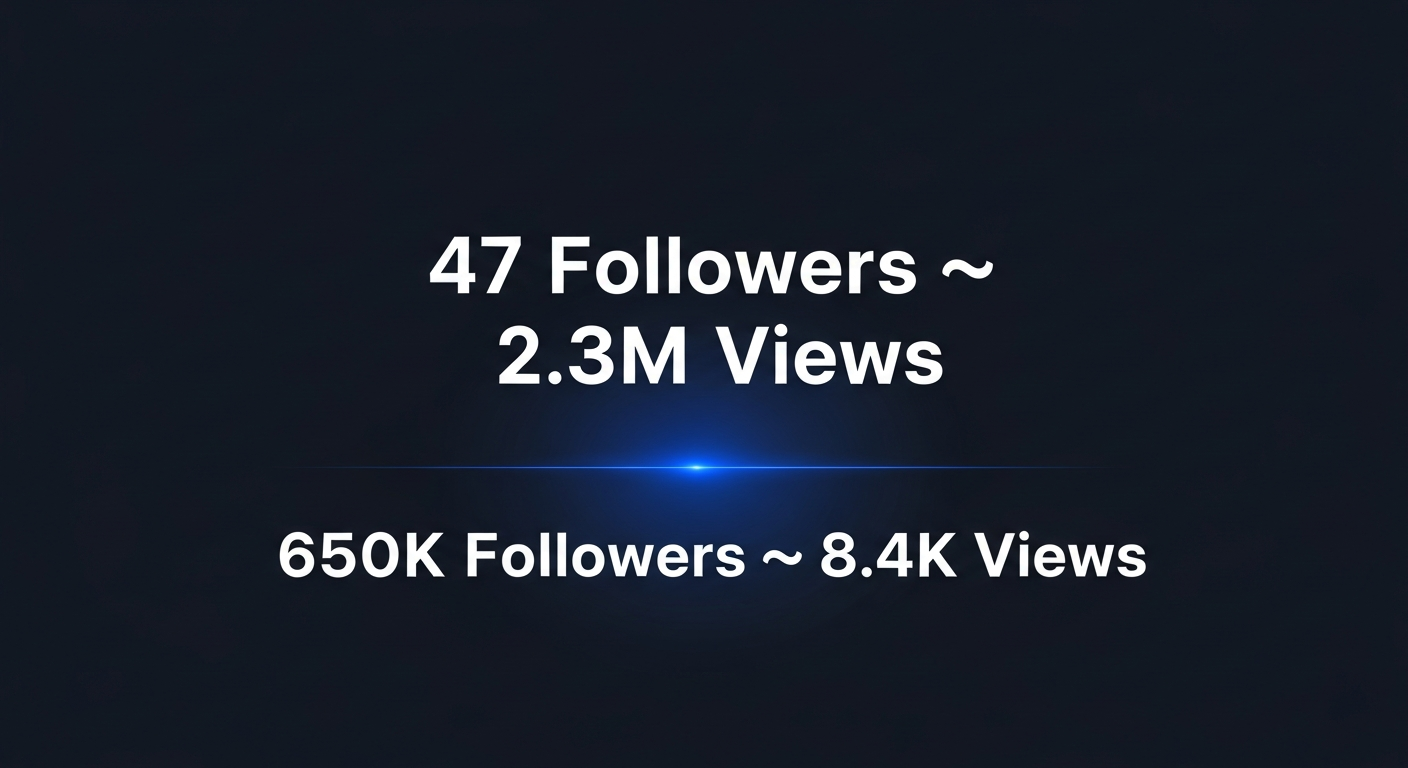
I watched a 47-follower TikTok account pull 2.3 million views on a single video last month. The creator didn’t spend a dime on ads, didn’t have a brand deal, didn’t even think of themselves as an “influencer.” Meanwhile, a macro-influencer with 650,000 followers posted on the same day and got 8,400 views.
This isn’t an outlier anymore. It’s the new normal.
Accounts with 100 followers are getting 1 million views. Influencers with 500,000 followers are getting 2,000 views. And brands are still writing checks to the accounts with big numbers.
The Algorithm Killed Follower Count. Most Marketers Haven’t Noticed.
Here’s what happened: platforms stopped rewarding follower counts around 18 months ago. YouTube Shorts doesn’t care if you have 10k or 10M subscribers—it distributes based on watch time and engagement velocity. TikTok’s algorithm has been ranking by authenticity and resonance for three years now, not follower size. Instagram Reels rewards saves and shares over likes, pulling content from micro-creators into 50M-view territories.
The platforms optimized for user retention, not creator hierarchy. A video from an unknown account that stops the scroll for 8 seconds gets pushed wider than a celebrity post that people scroll past in 2 seconds.
But here’s the thing—most brands didn’t adapt. They’re still looking at follower counts like it’s 2019. They’re still paying macro-influencers $50,000 for posts that underperform a teenager’s authentic rant. It’s not that the influencers got worse. It’s that the entire economy shifted under their feet, and they didn’t notice.
Why Micro-Creators Win
1. Algorithmic favoritism for new/small accounts
Platforms literally distribute content from smaller accounts more aggressively because the algorithm assumes unknown creators need reach to prove themselves. A 100-follower account gets a wider initial distribution burst than a 500k account posting the same content. The 500k account gets assumed to already have an audience.
2. Authenticity compounds across platforms now
Micro-creators usually have one or two platforms where they’re actually active, and they post authentic, unfiltered content because they’re not professional yet. That authenticity is catnip to algorithms right now. Meanwhile, macro-influencers post curated, branded, polished content—and algorithms deprioritize it because the engagement velocity is lower.
3. Niche communities have higher conversion
A 47-follower fitness nerd with a hyper-engaged community is worth 1000x more to a supplement brand than a macro-influencer with 500k followers and 0.3% engagement. The micro-creator’s audience actually listens. The macro-influencer’s followers forgot they followed them.
4. Cost per actual result dropped by 90%
You can work with 50 micro-influencers (100-10k followers each) for the cost of one macro-influencer ($50k+), and get 10x better results because niche communities convert. One micro-creator with a passionate audience moves more units than five macro-accounts combined.
The Three Plays Winners Are Running in April 2026
Play 1: Build your own micro-audience first (not as a stepping stone to macro)
Stop thinking of micro as a stage on the way to macro. Micro IS the destination. A YouTube channel with 8k subscribers but a 47% average view duration and 12% click-through rate is infinitely more valuable than 500k subscribers with 2% view duration. Build one platform to 5-15k highly engaged followers, then expand to adjacent platforms with the same community. Your engagement rate matters more than your follower count. Pick one platform, own it, then duplicate the play elsewhere.
Play 2: Partner with micro-creators who have 1-2% of your target market already (not celebrities in your niche)
Stop searching for “influencers in [your industry].” Search for creators in communities adjacent to your customer. If you sell productivity software, don’t pay a 200k-follower productivity guru. Find 30 creators with 500-5k followers in niche communities (ADHD communities, solopreneurs, indie hackers, etc.). They’ll deliver better results for 1/50th the cost. The spreadsheet-happy founder with 3k followers in the bootstrapper community will move more sales than the motivational speaker with 2M followers.
Play 3: Measure by conversion, not impression share
Stop asking “How many views will I get?” Start asking “How many customers will I get and at what cost?” A 100-follower account that converts 8% of viewers into customers is worth infinitely more than a 500k account converting 0.01%. Track affiliate links, promo codes, direct sales. If an influencer can’t prove conversion or engagement, they’re not an influencer—they’re a vanity metric.
What This Means for Your Brand Right Now
If you’re still allocating budget to follower count, you’re leaving 80% of your ROI on the table.
The brands winning in 2026 have flipped the script. They’re working with 50-200 micro-creators instead of 3-5 macro-accounts. They’re measuring engagement velocity, conversion rate, and community alignment instead of impressions. They’re rewarding creators with real influence—the kind that moves customers—not the kind with real follower counts.
This is exactly the kind of strategic shift that separates scaling brands from stuck ones. If you’re serious about viral growth in this environment, stop guessing and book a strategy session with me directly at EdwardRippen.com. I work with a small number of companies and founders each quarter, and if you want eyes on your growth strategy—especially around influencer partnerships and micro-creator ecosystems—let’s talk.
Everything I covered here goes 10x deeper in The Golden Goose Formula—my viral marketing strategy playbook where I break down exactly how to build communities and partnerships that actually move the needle. If you don’t have your copy yet, grab it at EdwardRippen.com.
The window for micro-creator advantage is closing fast. By late 2026, this will be the default. Move now while follower-count brands are still throwing money at the wrong accounts. Your competition is about to figure this out.