
Wellness Marketing 2026: Why Aspirational Marketing Is Killing Your Brand
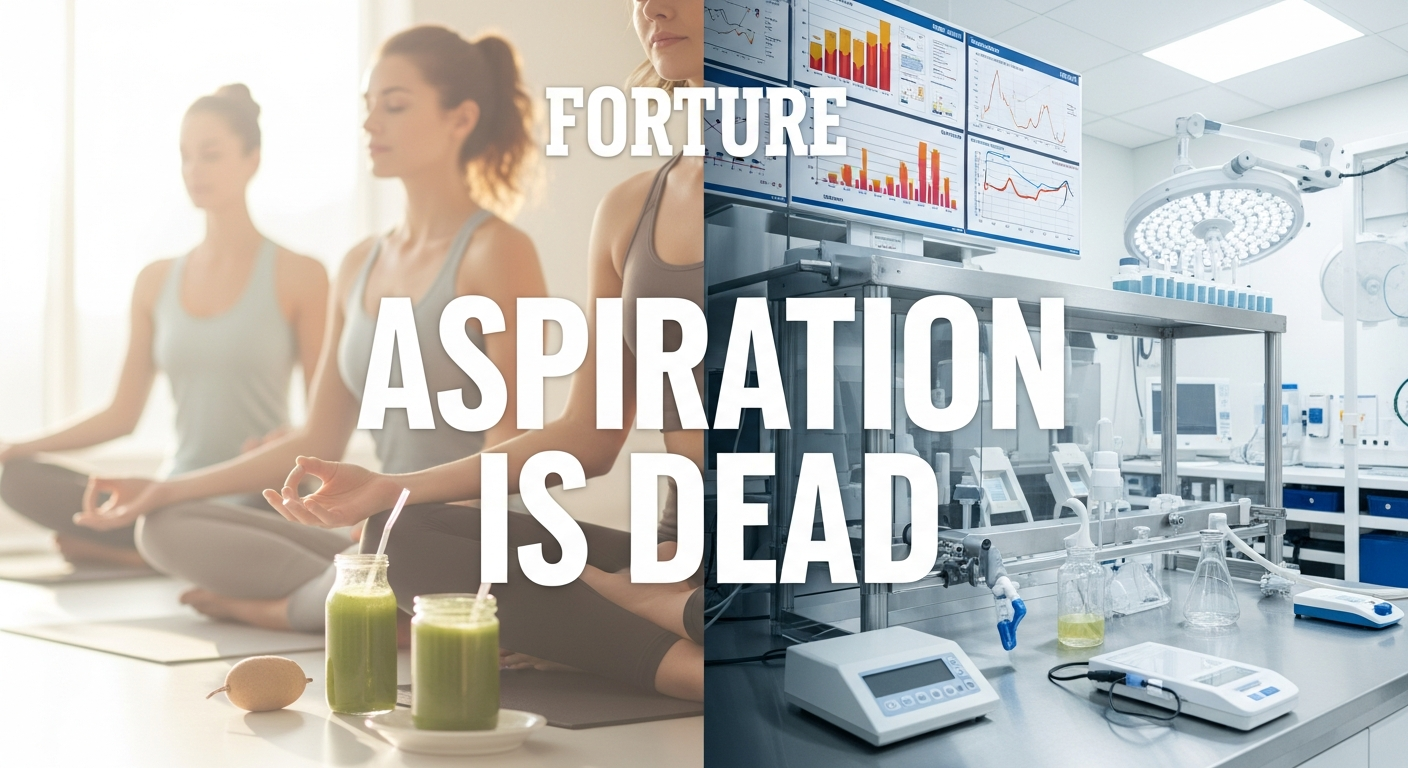
The wellness market is $6.5 trillion. Let that sit for a second.
Not aspirational wellness. Not “wellness lifestyle.” Not “self-care Instagram.” The actual, measurable, consumable wellness market is now larger than the GDP of most countries.
And I’m watching the same brands that dominate other categories get absolutely demolished here.
Why?
They’re selling feelings. They’re selling transformation. They’re selling the idea of wellness. And in 2026, that’s not enough anymore because consumers have fundamentally changed what they actually want from a wellness brand.
The Old Playbook Is Dead
For the last decade, wellness marketing was about aspiration.
Beautiful images. Sculpted bodies. Green smoothies sipped on white beaches. Transcendent meditation moments. The messaging was always: “Buy this, and become this.“
It worked. For a while.
Then something shifted.
Consumers got tired of buying promises they could never keep. Tired of products that looked great in ads but didn’t actually work. Tired of fake transformation narratives that made them feel worse about themselves.
So they started asking a different question: “Does this actually work?”
And that single question broke the entire aspirational wellness business model.
Today’s wellness consumer — and this is exactly the audience you want — is obsessed with proof. Not fantasy. Proof.
Here’s what the data shows: Personalization and scientifically-validated outcomes are now the primary purchase drivers for health and wellness products — not lifestyle branding. Consumers are 3x more likely to trust a brand that leads with clinical evidence, biomarker data, and transparent sourcing than one that leads with aesthetics (UPBEAT Growth, 2026).
The brands winning the $6.5 trillion wellness market are the ones who stopped selling transformation and started selling measurable results.
Three Brands Getting It Right (And Why)
1. LMNT (Electrolyte Drink)
They don’t sell “energy.” They sell sodium-potassium-magnesium balance. Their marketing is a breakdown of their formula, the science behind electrolyte depletion, and testimonials from actual endurance athletes and biohackers — not models. Their landing pages have clinical studies, not lifestyle photography.
2. Levels (Metabolic Monitoring)
A continuous glucose monitor isn’t aspirational. It’s data. Their entire marketing strategy is built on “see your metabolic response in real-time.” No promises of transformation. Just accountability and clarity.
3. Momentous (Athletic Nutrition)
Founded by Andrew Huberman’s research partner. Their marketing is the science. Ingredient sourcing. Protocol research. Dosage justification. They positioned themselves as the scientist’s choice, not the Instagram influencer’s choice.
All three: fastest-growing in their categories. None of them sell aspiration.
What Changed in the Wellness Consumer’s Brain
In 2026, wellness demand is segmented by life stage and specific health outcome, not age or income. A 35-year-old focused on longevity needs different messaging than a 35-year-old focused on athletic recovery. A woman optimizing for metabolic health needs different proof points than a woman managing hormonal balance.
The old playbook assumed everyone wanted to be the same “ideal.” The new playbook says: Your customer has a specific health problem. Prove you solve it.
Here’s the shift:
Old: “Become your best self with our juice cleanse.”
New: “Reduce blood sugar spikes by 23% with our adaptive nutrition protocol.”
Old: “Transform your body with our fitness program.”
New: “Increase VO2 max by 18% in 12 weeks. Here’s the program. Here’s the research.”
Old: “Glow from within with our supplement.”
New: “Our collagen shows a 34% improvement in skin elasticity in 8 weeks. Here’s the independent study.”
The brands that win are obsessed with one outcome, not everyone.
The Five-Step Playbook to Own Wellness Marketing in 2026
Step 1: Pick Your Specific Health Outcome (Not a Demographic)
Stop thinking about age or income. Start thinking about what specific health problem your customer is trying to solve.
Longevity? Energy management? Hormonal balance? Metabolic health? Gut health? Mental clarity?
Pick ONE. Be the expert on that one thing. Make your entire brand architecture, messaging, and proof point around that specific outcome.
The brands failing in wellness are the generalists. They’re trying to be for “everyone who wants to be healthy.” That’s not a strategy. That’s noise.
Levels (metabolic health). LMNT (electrolyte balance). Magic Spoon (low-sugar protein). Every winner I know has chosen their lane.
Step 2: Lead with Science, Not Story
Your first touchpoint should not be inspiration. It should be education.
The consumer’s question is: “Does this actually work?”
Answer that question before you ask for money.
This means:
- Show clinical studies (or commission your own — it’s cheaper than you think)
- Display your ingredient sourcing and dosage justification
- Publish before/after biomarker data (not photos)
- Use your landing pages to educate, not to sell
- If you don’t have clinical evidence, build it into your marketing timeline (and be transparent about it)
Andrew Huberman’s protocols are wildly effective in marketing wellness because every recommendation comes with research citations. His social media is basically “here’s the study, here’s what it means, here’s how to apply it.”
That’s not boring. That’s trustworthy. And trust sells at 10x the rate of aspiration.
Step 3: Build Personalization Into Your Offer
The wellness market in 2026 is obsessed with personalization.
Digital wellness (personalized apps, wearable integrations, biomarker tracking) grew 27.3% CAGR in 2024–2026. That’s double the growth of the broader wellness market (Future Market Insights, 2026).
This means:
- Use questionnaires to customize product recommendations
- Integrate with wearables (Apple Watch, Oura Ring, Whoop, Levels)
- Segment email by health outcome, not just demographics
- Offer personalized dosing or product combinations
- Use biomarker data (if you have it) to show individual results
Step 4: Make Transparency Your Unfair Advantage
Transparency is now table stakes in wellness. But most brands are still hiding their supply chain, their formula, their profit margins.
Be radically transparent.
Show where your ingredients come from. Explain your pricing. Publish your studies (even the ones that show mixed results). Be honest about what your product does and doesn’t do.
Brands that hide behind aspirational marketing are hiding something. Consumers know this.
The opposite signal — radical transparency — creates disproportionate trust.
Example: Magic Spoon publishes the exact reason their product costs what it does. Their marketing isn’t “affordable chocolate-flavored chaos.” It’s “Here’s our ingredient cost. Here’s our manufacturing. Here’s why we don’t use artificial sweeteners even though it would be cheaper.”
Step 5: Segment Your Messaging by Life Stage
The wellness market used to be “young, fit, healthy people who want to optimize.”
Not anymore.
Wellness demand now breaks down by specific life stage and outcome:
- Longevity & prevention (30s-70s): preventive supplements, metabolic monitoring, lifestyle tracking
- Athletic performance (20s-50s): protein, amino acids, recovery optimization
- Women’s health (20s-55s): hormonal balance, reproductive health, perimenopause/menopause
- Mental wellness (all ages): stress management, sleep optimization, mood support
- Metabolism & weight (30s-60s): glucose control, metabolic health, appetite management
Each segment has different primary concerns, different proof points, different purchasing behavior.
A woman in perimenopause doesn’t care about athletic performance optimization. A biohacker doesn’t care about sleep for “rest.” They care about sleep as a performance input.
Customize your messaging by life stage. Show the proof points that matter to that specific person.
The Closing Realization
The wellness market isn’t growing because people suddenly want to be healthier.
It’s growing because people have moved from “I want to look better” to “I want to be better — and I want to measure it.”
That shift breaks every brand that’s still selling aspiration.
The window to own a specific wellness niche right now is open. But it’s closing.
The brands that will dominate the next 24 months are the ones who:
- Pick a specific health outcome
- Build their entire strategy around scientific proof
- Make personalization the center of their offer
- Lead with transparency
- Segment by life stage
If you’re building a health or wellness brand, or if you’re a founder who wants to expand into the wellness space, this is the framework I use with every company I work with. It works because it’s based on what consumers actually want — not what marketers think they should want.
If you want to build a wellness brand (or marketing strategy) that actually converts, the first step is a strategy session. I work with a select number of health and wellness founders each quarter. If you want to map out your positioning, your proof points, and your go-to-market strategy, let’s talk. Book a consultation at EdwardRippen.com.
And if you want the full framework for building a category-killing brand in any space — including wellness — grab The Golden Goose Formula. It’s all in there: how to pick your niche, how to build proof, how to position like a category leader. Get your copy at EdwardRippen.com.
The window is open. The consumer is ready. The only question left is: are you?