
The Human Certification Movement: Why AI-Free Creative Is the New Luxury Brand
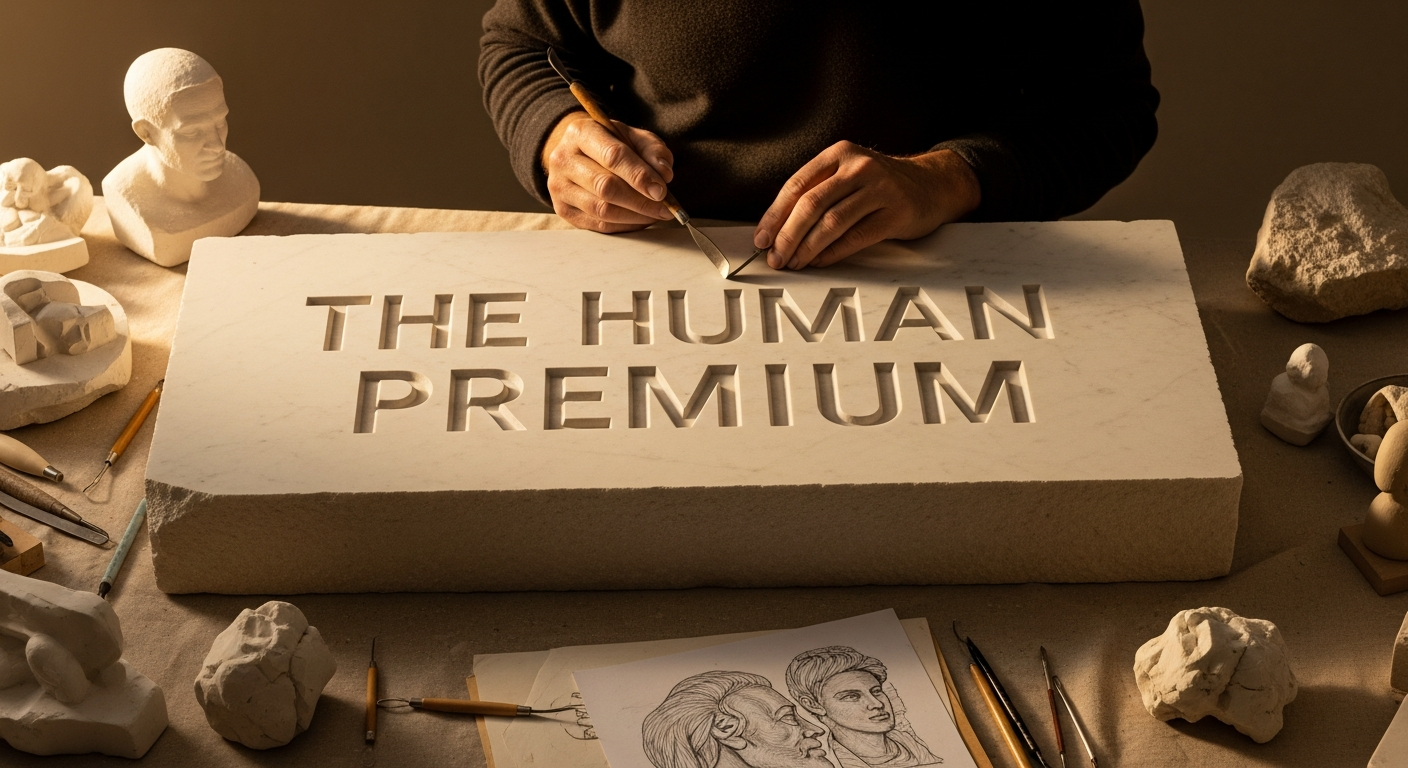
Brands are starting to demand proof that your logo, your video, your copy, your website design — actually came from a human. Not an AI. Not a hybrid workflow. Not “mostly human with some AI assistance.” Completely human-made.
This isn’t a fringe preference anymore. The Verge just reported on a growing movement to certify and authenticate human-made creative work. Apple TV’s Pluribus and iHeartRadio are leading the charge. And smart creators, agencies, and founders are already figuring out how to monetize this shift.
The irony is brutal: in 2026, when every agency is racing to deploy AI, the competitive advantage is becoming being able to prove you didn’t.
Why AI-Free Creative Is Becoming a Status Signal
Let’s be real about what’s happened in the last 18 months. Every marketer adopted AI. Every designer started with Midjourney. Every copywriter tested ChatGPT. And every brand that cared about standing out now looks exactly the same.
The result? A market saturated with indistinguishable creative. Polished. Efficient. Forgettable.
At the same time, clients are getting burned. They hired an agency, got back “AI-enhanced” assets, and discovered their competitor had the exact same design. Or worse — a customer recognized the telltale signs of AI copy and lost trust instantly.
Enter the human certification movement. It’s solving two problems at once:
For creators and agencies: A way to differentiate in a crowded market and charge premium pricing for the extra work.
For brands and clients: Proof of authenticity, originality, and real human thought — the exact opposite of what everyone else is selling.
This is the same dynamic that made “organic” a billion-dollar label in food. People will pay more for proof that something was made the “old-fashioned” way. In 2026, that “old-fashioned way” in creative is just… being human.
The Market Is Already Pricing It In
High-end brands are already willing to pay premium rates for certified human-made work. Luxury brands, personal brands, premium agencies, and founders building differentiated products all understand one thing: if your brand story is AI-generated, it’s not your brand story.
I’ve seen premium positioning work pay 2x, 3x, even 5x the standard rate once a creator or agency can credibly claim: “This was 100% human-made. All original. Not touched by AI.”
And here’s the kicker — the clients asking for this aren’t price-sensitive. They’re quality-sensitive. They’re brand-sensitive. They’re the exact clients you want.
What’s emerging in 2026 is a two-tier creative market:
Tier 1: AI-Augmented Efficiency Plays
Fast, cheap, competent. Good for commoditized work. Zero differentiation. Race to the bottom on price.
Tier 2: Human-Certified Premium
Slower, more expensive, defensible. Good for brand-building, positioned clients, and anything that requires originality. Premium margins. Sustainable business.
The question isn’t “Should I use AI in my workflow?” The question is “Can I credibly prove that I didn’t, or better yet, that I chose not to?”
How to Position Human Certification as Your Unfair Advantage
1. Get Ahead of the Certification Wave
Right now, there’s no unified “AI-Free Certified” badge standard. Apple, The Verge, and others are working on it. But there will be. And the creators and agencies who establish their human-made credentials first will own the category before the certification bodies catch up.
Start now: document your process. Show the drafts. Share the behind-the-scenes. Prove that a human sat down and thought about this. And make it part of your pitch.
2. Turn It Into Your Positioning Narrative
Don’t just say “We don’t use AI.” That’s defensive and weird. Instead, own the philosophy:
“We believe original thinking comes from human creativity, not prompt engineering. Every piece of work that leaves our studio is 100% human-conceived and human-executed. That’s why our clients get work that actually stands out.”
This is positive. It’s confident. It attracts the right clients — the ones who care about standing out, not just checking boxes.
3. Price It as a Feature, Not a Philosophy
Certification costs you time. Proving provenance takes process. Documenting the creative journey adds friction to your workflow. These are real costs, and they should be reflected in your pricing.
When pitching a premium brand or founder, position it this way: “Our human-certified rate is 35% higher than our AI-augmented rate. Here’s why it’s worth it…”
Then show them the results — brands that stick out, positioning that holds, creative that doesn’t expire when the next AI model drops.
4. Target the Right Clients
Not every client wants human-certified work. Commodity businesses, price-driven sectors, and businesses optimizing purely for efficiency will still want AI-augmented teams.
But luxury brands, personal brands, founders building premium positioning, and anything relying on authenticity as the core value prop — those clients will pay the premium.
Build your pitch around them. Ignore the rest.
5. Lean Into Transparency
The most convincing proof of human-made work isn’t a badge — it’s showing the process. Share your sketches. Post the iterations. Show the thinking behind the creative decisions. Let clients see the messiness of real human creativity, not the polish of an AI output.
This does two things: it proves authenticity and it builds perceived value. Clients invest emotionally in the journey, not just the outcome.
The Real Play: It’s About Belief, Not Biology
Here’s what most people miss about the certification movement: it’s not really about whether a human or AI touched the work. It’s about belief and positioning.
Clients who buy human-certified creative are buying into a story: that someone cared enough to think deeply, iterate carefully, and put their reputation on the line for the work. That story is worth money.
The irony is that if you’re actually good, a hybrid workflow might make your work better. But if the market is willing to pay premium for human-only work, and you can deliver it, that’s the play in 2026.
The brands winning right now are the ones who figured out that in a world flooded with AI, the most valuable thing you can sell is the opposite: the credible claim that something is irreplaceably human.
And that premium positioning? It sticks around long after the AI hype dies. It becomes your brand.
What This Means for Your Business
If you’re a creator, designer, copywriter, or agency: the window for positioning yourself as human-certified is open right now. Establish your methodology. Document your process. Make it part of your brand story. And price accordingly.
If you’re a brand or founder: understand that AI-skeptical buyers are growing, and they’re willing to pay more for human-made work. This is a positioning opportunity, not a liability.
The question isn’t “Should we use AI?” The question is “What are we actually selling, and to whom?” If you’re selling commodities, AI wins. If you’re selling authenticity, originality, or premium positioning, human-made becomes your unfair advantage.
The smart move in 2026 isn’t racing to the bottom with AI. It’s establishing the high-end positioning that the market is finally willing to pay for.
The brands and creators who move first on human certification will own the premium tier of their market. Don’t wait for the standards to get set. Set them yourself.
If you want to explore how to position your creative work or brand around authenticity and human value, I work with a small number of creators, agencies, and founders each quarter on premium positioning strategy. Let’s talk — book a consultation at EdwardRippen.com.
And if you want the full framework for building a defensible brand positioning that charges premium pricing, The Golden Goose Formula walks you through the entire system. Grab it at EdwardRippen.com.
The certification movement is just getting started. Move now, or explain later why you waited.