
Ad Revenue Is Dead: The Creator Product Empire Playbook for 2026
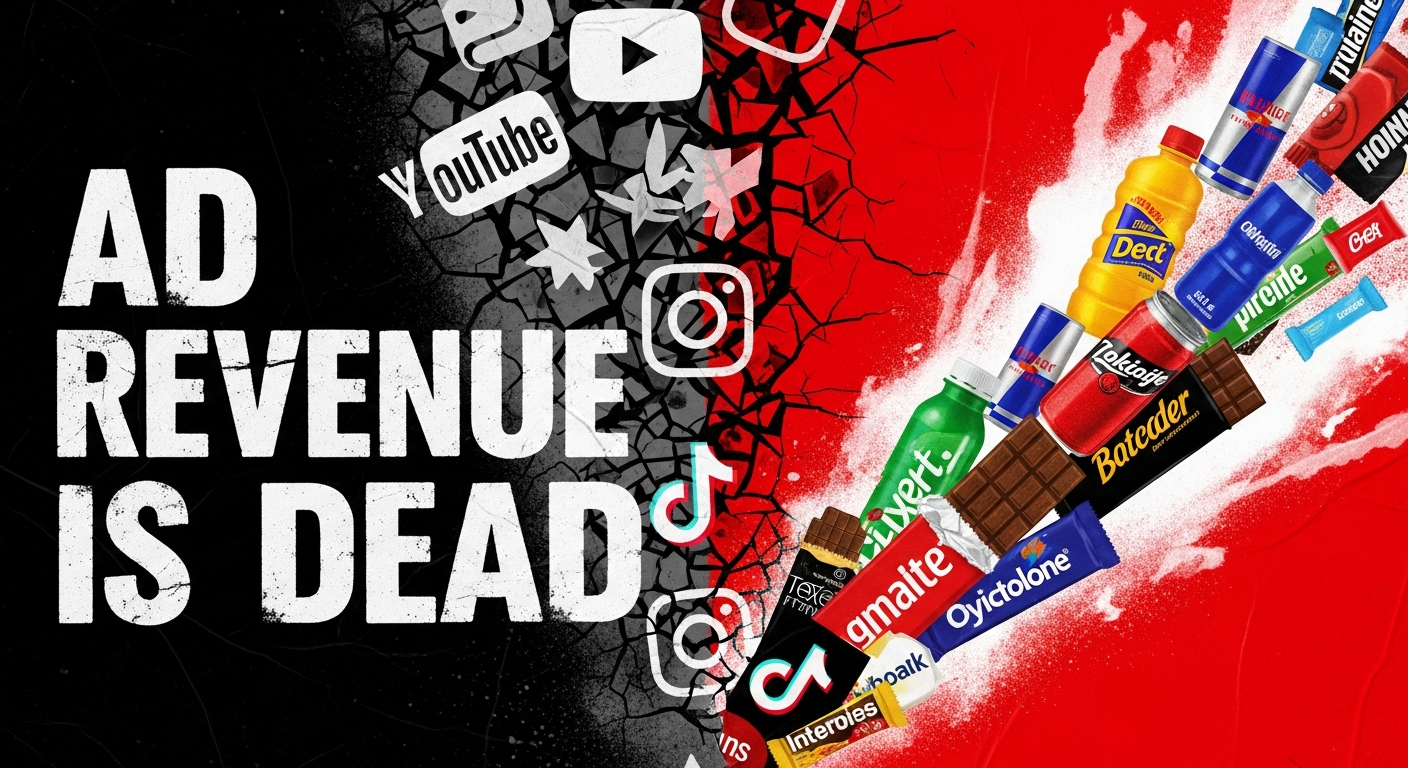
The creators crushing it in 2026 aren’t betting on YouTube CPM or platform payouts. They’re building product lines that generate hundreds of millions in revenue—independently of any algorithm.
MrBeast sold $600 million worth of Feastables chocolate bars without a single TikTok sponsored post. Logan Paul’s Prime energy drink does more annual revenue than most VC-backed startups. Andrew Tate’s Hustler’s University made north of $100 million before imploding in legal chaos.
The pattern is unmistakable: the money moved. It’s no longer in ad revenue, sponsorships, or even Patreon. It’s in building actual products and creating ecosystems where your audience becomes your customer base, your supply chain validator, and your growth engine all at once.
The creators who understood this 18 months ago are now running companies, not channels. And the ones still chasing algorithm metrics and ad rates are watching their relevance erode in real time.
Why Ad Revenue Was Always the Trap
Let me be blunt: if your business model is “more views = more money,” you’ve already lost.
YouTube pays between $0.25 and $4 per 1,000 views depending on geography, time of year, and audience type. TikTok pays less. Instagram even less. A creator with 10 million followers can grind for months and pull in $50K in ad revenue while their audience is worth millions in purchasing power sitting right in front of them—literally demanding to give them money.
The platform owns the relationship. They own the algorithm. They own the distribution. You own the eyeballs, but you don’t own the monetization.
The smartest move a creator can make is to stop treating the platform as the revenue stream and start treating it as the acquisition channel. YouTube isn’t your business—it’s your funnel.
Feastables proved this. Prime proved this. Even the explosion of creator-backed courses, coaching, and membership communities proved this years ago. But the difference now is scale: creators with 1-5 million followers are building product lines that do $50-500M annually, and they’re doing it in 12-24 months.
The Creator IP Product Empire Model (Broken Down)
Building a creator product empire isn’t about slapping your name on a t-shirt and calling it a day. The winners follow a specific sequence:
Step 1: Own the Category (or Create One)
MrBeast didn’t enter the saturated energy drink market. He created “premium, guilt-free chocolate.” Prime positioned as the “hydration drink for Gen Z.” Both created a category moat, not a product moat.
Your first product should define a gap so specific that your audience thinks “oh, this is obviously what I needed.” It should feel inevitable when they see it, not like a cash grab.
Step 2: Use Your Audience as Product Validation
The advantage you have over traditional CPG brands is insane: you can test, iterate, and validate with your community before major manufacturing commitments. Feastables dropped a limited run to a waitlist. Prime beta tested flavors with creators and fans. Both used their audience as the R&D department.
This collapses the traditional product development timeline from 18 months to 3-6 months.
Step 3: Integrate the Product Into Content
This is where most creators fail. They make a product, then awkwardly try to sell it. Winners integrate it into the content experience itself. MrBeast gives away Feastables in videos. Logan Paul wears Prime like a personality trait. The product becomes part of the entertainment, not separate from it.
Your audience doesn’t want to be sold to—they want to participate in your story. If the product is part of the story, they’ll buy.
Step 4: Expand Vertically and Horizontally
Once you nail one product, the real empire building begins. Feastables moved into protein bars, snack lines, and bundled offerings. Prime went from energy drinks to related sports nutrition. Each expansion compounds the equity of the brand.
But here’s the critical part: you’re not diversifying away from your core audience. You’re deepening their engagement with adjacent problems you can solve.
Step 5: Build Merchandising and Brand Extensions
Your audience will buy anything with your brand on it—if it’s authentic. T-shirts, hats, hoodies, collectibles, limited editions. But the real money is in the product ecosystem: the clothing becomes part of the cultural identity around your brand.
Logan Paul’s Maverick brand isn’t just merch—it’s a lifestyle positioning. Same with MrBeast’s branding across all his products. They’re not selling products; they’re selling membership into a community.
The Hidden Advantages You Already Have
As a creator, you have asymmetric advantages over traditional CPG companies:
Direct distribution channel: Every video, post, and story is a potential sales opportunity. A traditional brand pays millions for that kind of access. You own it.
Community trust: Your audience chose to follow you. That’s a relationship that didn’t cost you millions in ad spend to build. CPG companies would kill for that kind of brand trust with a demographic segment.
Built-in demand validation: If your audience is asking for a product, and they’re willing to wait for it, you already have PMF. Traditional companies spend hundreds of thousands on market research to figure this out.
Content as marketing: Your product footage, unboxing videos, before-and-after content, and community testimonials are all free marketing. Traditional brands hire agencies for this. You generate it organically.
Speed to market: You can launch a product, test it, pivot it, and scale it 10x faster than traditional retail chains. Your community is forgiving of iteration if they feel heard in the process.
The Three Product Archetypes That Scale
Not every creator product works. But there are three archetypes that consistently convert audience into revenue:
1. The Aspiration Fill
Products that let your audience feel like they belong to your inner circle. Prime and Feastables are aspiration fills: buying the product makes you part of the movement. Jake Paul’s Maverick brand, Mr. Beast’s gear—all aspiration fills.
This works best if your audience admires you or wants to emulate your lifestyle. High margins, high repeat purchase potential, deeply tied to community identity.
2. The Problem Solver
A product that genuinely solves a problem your audience articulates. This could be productivity tools, fitness supplements, software, courses, or services. The key is that it directly addresses pain your audience communicates to you.
Examples: Productivity creators building apps, fitness creators building supplement lines, business creators building coaching memberships. The trust is higher because the need is explicit.
3. The Collectible/Experience
Limited editions, exclusive drops, NFTs (if you’re insane), early access products, or experiences (events, summits, workshops). These trade on scarcity and status, not utility.
Think Supreme, limited edition video game drops, or exclusive creator meetups. High perceived value, extremely high margins, but requires careful positioning to not feel predatory.
Where Most Creators Fail
I’ve watched dozens of creators launch products. Here are the failure modes:
Launching too generic: “Energy drink from a creator” is not a positioning. “Hydration built for gamers who stream 12 hours a day” is. Your product needs a specific point of view.
Outsourcing authenticity: You hire an agency, they design the product, you put your name on it. Your audience can smell that from a mile away. The best creator products have the creator’s fingerprints all over the development process.
Prioritizing margin over quality: You cut costs on manufacturing to hit a 70% margin target, and the product is mediocre. Your audience will buy once, feel disappointed, and never come back. You just burned equity that took years to build.
Using the platform wrong: You make a 30-second ad and think that’s marketing. It’s not. You need to integrate the product into your actual content narrative. It has to feel like a natural part of your world, not an interruption.
Not reinvesting in product innovation: You launch one product, it hits, you coast. Meanwhile, a competitor with a smaller audience drops a better product in your category, and suddenly you’re yesterday’s news.
The 2026 Playbook for Your First Creator Product
Month 1-2: Validate the idea
Survey your community. Ask them directly: “If I launched a product that solved X, would you buy it?” Don’t guess. Make them vote with a poll, email signup, or Discord discussion. If you’re not getting 70%+ “yes” responses, the idea isn’t ready.
Month 2-3: Spec and develop
Partner with a manufacturer, co-develop with a brand consultancy, or use a white-label supplier. But stay involved. The product should reflect your values, your taste, your standards. If you’re not willing to use it yourself, don’t launch it.
Month 3-4: Create a pre-launch waitlist
Build hype by giving your community exclusive access to the product development process. Show unboxing tests, ask for feedback on flavors or designs, share behind-the-scenes content. By launch, you already have buyers lined up.
Month 4-5: Limited launch and content integration
Launch with scarcity: “First 10,000 units sold out in 48 hours” is a real story. It creates FOMO and validates demand. Integrate heavily into your content. Show yourself using it, eating it, wearing it, loving it.
Month 5-6: Analyze and iterate
Look at reviews, community feedback, return rates. What needs to improve? What variations do people want? Start planning the next product line or expansion based on data.
Month 6+: Scale and expand
Once you prove it works, scale production, explore new distribution channels (retail, Amazon, TikTok Shop), and develop complementary products. Your first product is just the beachhead.
The Real Economics: Why This Beats Ad Revenue
Let’s do the math on a real example:
Creator with 5 million followers, 500K monthly views, healthy engagement. YouTube ad revenue: roughly $2,500-$10K per month depending on audience geography. Let’s say $5K/month = $60K/year. That’s respectable, but it’s dependent on the algorithm not changing, platform policy not shifting, and CPM rates not cratering (which they do every quarter).
Same creator launches a product line. Conservative estimate: 2-5% of their monthly audience buys once per quarter. At a $30 product with 50% margins, that’s 10,000-25,000 units per quarter = $150K-$375K in gross revenue at a 50% margin = $75K-$187K in profit per quarter.
That’s $300K-$750K annually in gross profit from one product. That’s 5-12x the ad revenue. And it’s recurring (people reorder), it compounds (new customers), and it’s not dependent on algorithm changes.
Most creators take 2-3 years to build audience to the 5M follower mark. Then they spend 10+ years chasing ad rates. A creator product empire can be built in 18 months if you move fast and execute.
The Mindset Shift You Need
This is the hard part: most creators have been conditioned to see their audience as CPM-generating machines. “More followers = bigger check.” That mindset kills product businesses.
The winning mindset is this: your audience is a customer base. They’re not there to generate ad impressions. They’re there because they believe in you, and they’re willing to spend money with you.
Every product you launch is a chance to deepen that relationship and prove you understand their needs. Every purchase is an investment in your brand equity. Every repeat customer is a flywheel that makes the next product launch easier.
The creators dominating 2026 aren’t the ones with the biggest reach. They’re the ones who flipped the switch from “build audience for ad revenue” to “build audience to build a company.”
Your platform is not your business. Your product is. Your audience is not your ad inventory. They’re your market. And your job is to serve them so well that they can’t imagine NOT buying from you.
The window for this shift is closing. In 2 years, the creators who didn’t move into product empires will be irrelevant, and the ones who did will own entire categories in their niches.
The One Thing You Can’t Fake
I’ve seen creators with smaller audiences out-earn creators with massive reach because they had something the big names didn’t: genuine conviction about their product. They really believed in what they built. Their community felt it.
The opposite is also true. I’ve seen mega-influencers launch products that felt like cash grabs, and they flopped spectacularly because the audience sensed the inauthenticity.
So before you launch anything, ask yourself: “Would I buy this even if I didn’t have a platform?” If the answer is no, your audience will sense it, and your product empire will be stillborn.
But if the answer is yes? If you genuinely believe this product solves a real problem for people you care about? Then you have the only real competitive advantage that matters: authenticity at scale.
What Happens Next
The creator IP economy is still in its infancy. We’re at the point where the models are proven but not yet systematized. The real opportunity is for creators who understand the playbook, move fast, and execute with conviction.
In 12 months, this will be table stakes. Every creator over 1M followers will have a product line. In 3 years, the product will be their primary business and the content will be the marketing arm, not the other way around.
The money’s not in the content anymore. It’s in the products you create for the people who love your content.
If you’re serious about building a real business—not just a channel—book a strategy session with me at EdwardRippen.com. We’ll map out your product empire roadmap and figure out exactly where to start. I work with a limited number of creators and founders each quarter, and product strategy is one of my core focus areas. Spots fill up fast.
And if you want the complete framework for how to build products that actually move the needle with your audience, grab The Golden Goose Formula. The entire product monetization playbook is inside—the same system I use with every creator and brand I work with. Get it at EdwardRippen.com.
The creator economy’s second act has already started. The question is whether you’re in the audience or on the stage.