
Marketers Are Becoming Product Managers (And Most Don’t Know It Yet)
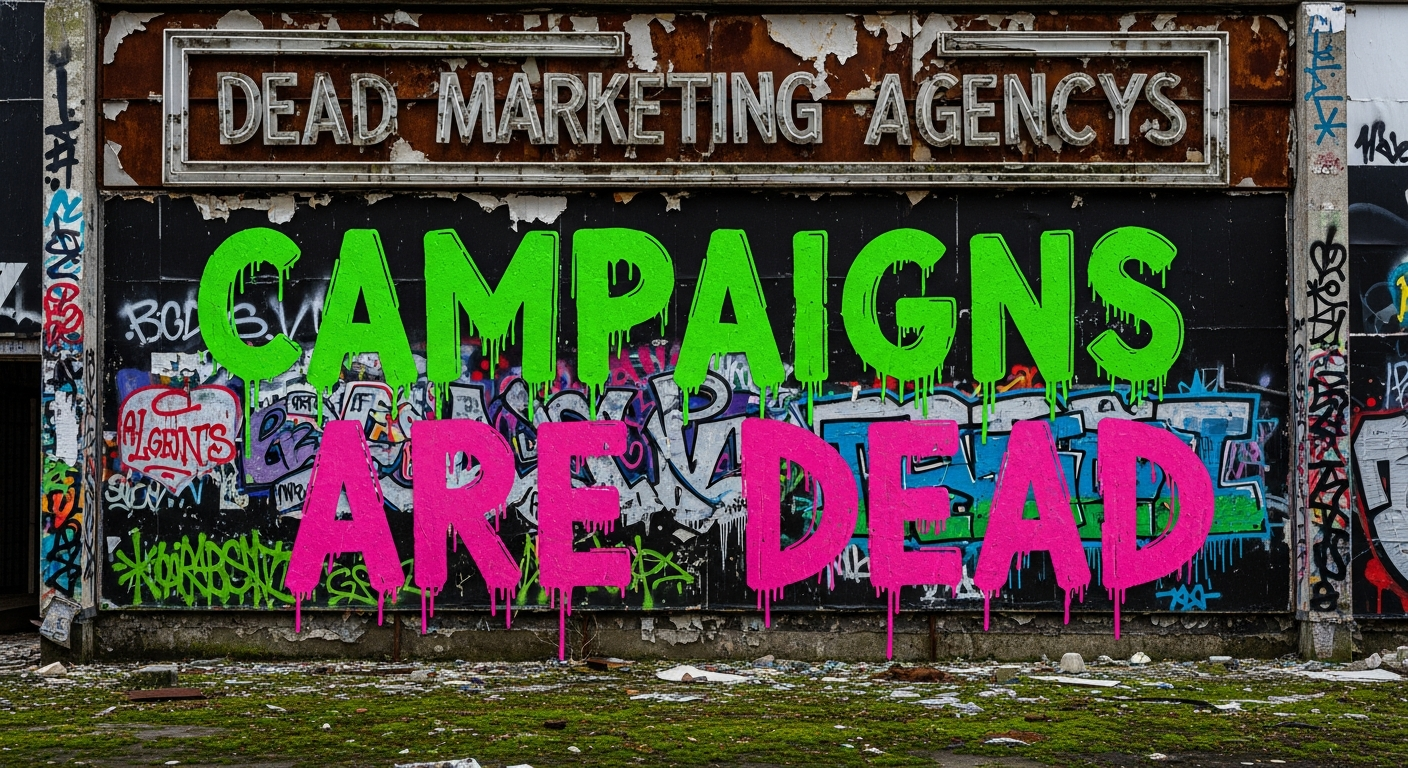
The best marketers I know don’t think about campaigns anymore. They think about products.
Not the product your company sells—the product they’re building for their audience. A community. A content series. A tool. A loyalty program. A direct channel that exists entirely outside of owned media platforms and ad networks.
This is the shift happening right now in marketing, and if you’re still optimizing campaigns on Meta and Google, you’re already behind.
Why Campaign Marketing Died (And You Probably Didn’t Notice)
For the last 15 years, the marketing playbook was predictable: build landing page → run ads → measure CAC → scale if profitable. Rinse, repeat. Channels changed (Facebook to TikTok, SEO to AI Mode), but the framework stayed the same.
That framework is collapsing.
Here’s why: every platform that marketers rely on has become increasingly hostile to extracting value. Meta’s organic reach is functionally dead. Google’s AI Mode shows answers without sending traffic. TikTok’s algorithm rewards native content, not ads. And the cost to acquire attention through paid channels has become economically insane for most businesses.
At the same time, the brands that are actually winning are building their own products—even if they don’t call them that. They’re creating loyalty programs that feel like exclusive apps. They’re building communities on Discord that drive retention and referrals. They’re launching content franchises that are more valuable than the product itself. They’re treating their audience relationship as a venture in its own right.
This isn’t a content strategy. This is product development.
The Product Manager Mindset Changes Everything
A campaign marketer asks: “How do I get people to click?”
A product marketer asks: “What are we building for them to stay?”
This distinction matters because it flips your entire operational model. Instead of optimizing for conversion on a landing page, you’re designing for engagement, retention, and network effects. Instead of budgeting for paid spend, you’re budgeting for product development. Instead of measuring CAC, you’re measuring lifetime value and activation rate.
I’ve watched companies make this shift in real time. A SaaS founder I worked with spent 18 months running a community (just Discord, nothing fancy). No ads. No landing page optimization. Just building a space where founders could ask questions, share wins, and feel less alone. By month 18, 60% of her customer base was coming from that community. Her CAC dropped by 70% because the product was the acquisition channel.
That’s product thinking.
Another example: a bootstrapped founder in the wellness space launched a weekly email series that was genuinely more valuable than his app. The email had callbacks, recurring characters, storytelling. People forwarded it. They shared it. They asked friends to subscribe. Within 6 months, his email list was 40K strong—all organic. That’s not a newsletter. That’s a product.
The common thread: these marketers stopped asking “How do I acquire customers?” and started asking “What do we build that makes people want to stick around?” The acquisition became a side effect of the product.
What This Actually Means for Your Team and Roadmap
If you’re running a marketing team and you’re not prepared for this shift, you’re making a mistake. Here’s what’s actually changing:
1. Your Marketing Budget Becomes Your Product Budget
Stop thinking of marketing as a line item. Think of it as a product investment. If you have a $100K quarterly budget, you’re not splitting it across Facebook, Google, and content creation. You’re asking: “What product can we build for our audience with this $100K?” Maybe it’s a tool. Maybe it’s an app. Maybe it’s a membership community. Whatever it is, it needs to function as a real product—with UX, iteration, feature velocity.
2. Hiring Changes Completely
You don’t need another paid media specialist. You need a product manager. You need an engineer or no-code builder. You need a designer who understands user flows. The traditional “marketing” skillset (paid ad optimization, funnel analysis) is becoming commodity. The premium skill is building something people actually want to use.
3. Success Metrics Flip
Forget CAC. Start measuring: activation rate (% of users who do the key action), retention rate (% who come back), viral coefficient (how many new users come from existing users), and lifetime value (total revenue generated per product user over time). These are product metrics, not marketing metrics.
4. You Need a Product Roadmap, Not a Campaign Calendar
Instead of “January: Facebook campaign, February: email launch, March: LinkedIn ads,” you’re thinking in quarters and releases. “Q2: build community features, Q3: launch referral mechanics, Q4: premium tier.” This is how you think about real products.
5. You’re Building Moats, Not Funnels
The old playbook had a finish line: conversion. You got the customer, and marketing’s job was done. Product-led marketing doesn’t work that way. You’re building something defensible. A community that only exists in your space. A tool that’s so valuable people would pay for it. A content format that competitors can’t copy because they don’t have the distribution or the brand equity.
The Three Types of Products Marketers Are Building in 2026
The Community Product
Discord servers, Slack communities, in-house forums—places where your audience creates value for each other. The marketing team becomes the product team: hiring moderators, designing flows, creating events, managing growth. This is how the best founders are building moats right now. It’s not a side project; it’s the business.
The Content Product
Serialized shows, recurring characters, branded IP. Think of it like a TV show, not a YouTube channel. There’s narrative continuity. There’s a reason people come back. It’s structured like a product with seasons, episodes, and evolving story arcs. Your job isn’t to make viral videos; it’s to build a franchise that generates recurring engagement and becomes fundable in its own right.
The Tool/Utility Product
Free tools that solve a specific problem for your customer. An AI tool that writes better briefs. A calculator that shows ROI. A tracker that measures something they care about. These become acquisition engines. They’re also valuable enough that they become your defensible asset.
All three have something in common: they function as real products. They have UX. They have metrics. They have roadmaps. They’re not campaigns wrapped up and shipped. They’re ongoing projects with iteration cycles.
How to Make the Transition
Start Small, But Start Now
You don’t need to rebuild your entire marketing operation in 90 days. Pick one product you want to build. It could be a Discord community, a weekly email series, or a free tool. Allocate 30% of your team’s time to it for one quarter and measure the impact. If it works, you’ve found your new growth engine. If it doesn’t, you’ve learned something valuable and you iterate.
Hire or Recruit for Product Thinking
You have people on your team right now who think like product managers but have been forced to live as campaign executors. Find them. Give them space. If you need to hire, look for people who’ve built communities, launched products, or run SaaS onboarding. Their skills transfer directly.
Change How You Measure Success
Stop reporting on vanity metrics. Your CEO doesn’t care that you reached 50K impressions. They care that you built something that’s generating revenue, retention, and word-of-mouth growth. Start reporting on activation, retention, and LTV. Make those metrics non-negotiable.
Build in Public
The best products are built with feedback from the market. Don’t wait for perfection. Launch your community, your content, your tool at 60% done. Share your roadmap. Let your audience help you build it. This turns them from customers into investors in what you’re creating.
Think in Quarters, Not Months
Products don’t get built in a month. They get built in quarters and years. This requires a shift in how you think about planning. You need a roadmap that extends 12 months out, with clear milestones for each quarter. This is uncomfortable for marketers trained to think in 30-day campaigns. Get comfortable with it.
The Competitive Advantage Is Massive
Here’s what you need to understand: the brands that make this transition will own their customer relationship in a way that Facebook, Google, and TikTok can never touch. They’ll have lower CAC, higher LTV, and a business that’s not dependent on algorithm changes or ad platform policy shifts.
Meanwhile, everyone else will keep optimizing their conversion rates on landing pages and wondering why CAC keeps rising.
The window for this shift is still open—most of your competitors haven’t even started thinking this way. But it won’t be open forever. By Q4 2026, the brands that are winning will be unrecognizable from the ones running traditional campaigns.
The question isn’t whether you should start thinking like a product manager. The question is how fast you can make the transition before your category is owned by someone who already has.
The Move You Need to Make Right Now
Stop asking “How do we acquire more customers?” Start asking “What product can we build that makes customers not want to leave?”
This is the only question that matters in 2026. Everything else is just noise.
If you’re ready to think about your marketing as a product discipline—not a campaign function—I work with a small number of companies each quarter on exactly this transition. We audit your current acquisition model, identify the product opportunity that will become your actual moat, and build the roadmap to execute it. If you want strategic eyes on how this looks for your business, book a consultation with me at EdwardRippen.com.
And if you want the full system for how to think about product-led growth, marketing strategy, and building defensible customer relationships, grab The Golden Goose Formula. It’s where I break down exactly how to build products that people actually want, and how to structure your marketing around them. Get it at EdwardRippen.com.
The brands that win don’t get attention. They build products worth paying attention to. It’s time to make that shift.