
Search Everywhere Optimization: The SEO Playbook for 7 Platforms (Not Just Google)
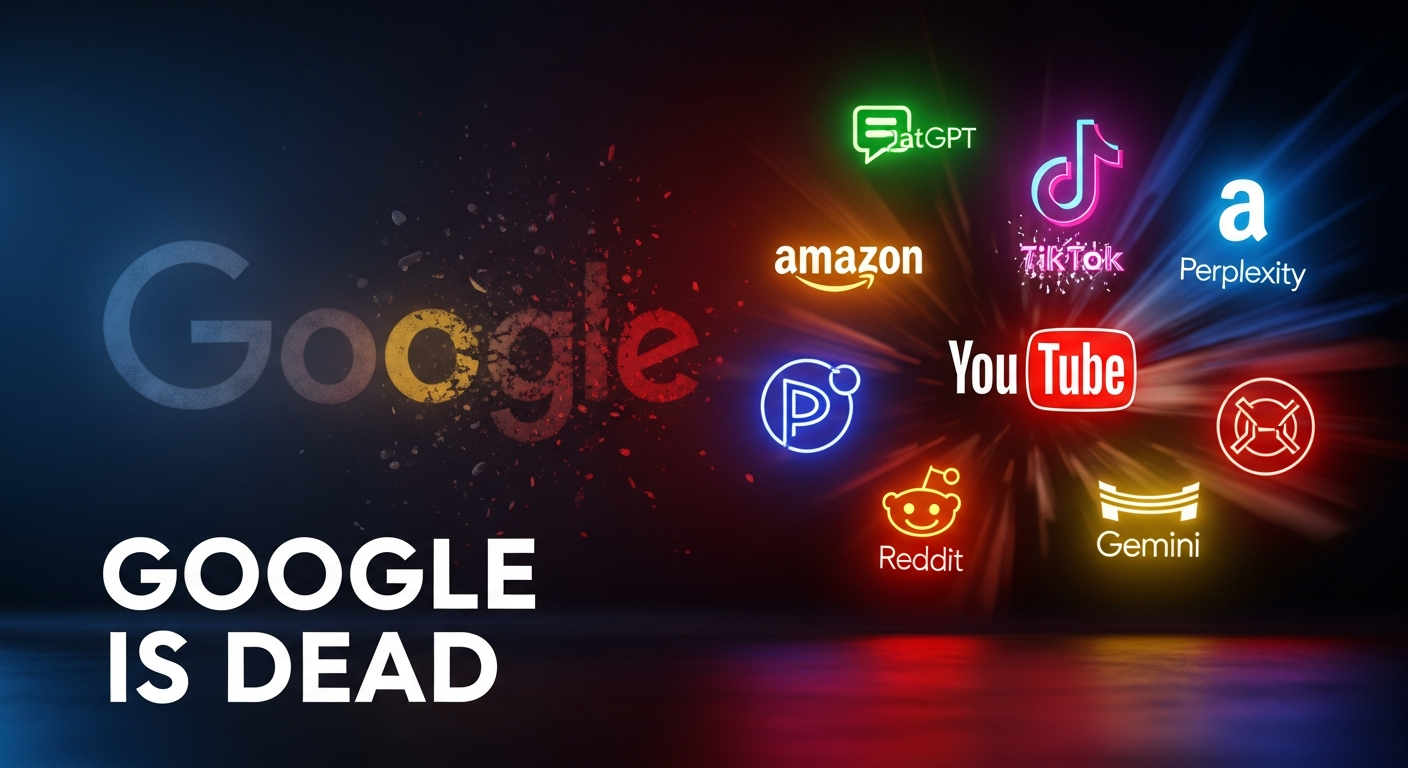
Your content strategy is still built for a 2015 Google. Here’s what it should look like in April 2026.
Stop me if you’ve heard this before: “We need to rank on Google.” You’ve heard it in every content meeting for the last decade. It’s dead. Not dead like “AI will kill marketing” dead. Dead like your flip phone is dead.
In 2026, “search” doesn’t live on one platform anymore. It lives on seven. ChatGPT. Perplexity. Google Gemini. TikTok. Amazon. YouTube. Reddit. And the brands winning are the ones building a Search Everywhere strategy—not an SEO strategy.
Here’s what I’ve seen happen in the last 90 days: companies with solid Google rankings are getting crushed by competitors they’ve never heard of. Why? Because those competitors understand that search behavior has fundamentally fragmented. Google still matters. But it’s not the only place your customers are discovering solutions.
Why Your Old SEO Strategy Is Obsolete
You know the stat: 25 billion Google Lens queries per month — that’s more than double what it was 18 months ago. But here’s the thing nobody tells you: those aren’t traditional text searches. They’re visual searches. Camera searches. “Show me what I’m looking at” searches.
Meanwhile, “Gemini” is the #1 trending search term in the US right now — Think with Google, March 2026. Not “how to use Gemini.” Not “Gemini vs ChatGPT.” Just “Gemini.” People are moving their search behavior to AI platforms because AI search feels faster, smarter, and less spammy than Google.
Here’s the kicker: Search Everywhere Optimization is now the dominant visibility strategy replacing traditional SEO — Think with Google, Digital Marketing Trends 2026. One platform is dead. Seven platforms are live.
Your competitors aren’t writing for Google anymore. They’re writing for the algorithm that powers discovery on ChatGPT. They’re optimizing for real-time search on Grok. They’re shipping TikTok content that ranks on TikTok search before it ever hits Google. And they’re watching their costs per acquisition drop while yours stay flat.
The Seven Platforms You Need to Own
This isn’t theory. I’m watching this play out with founders and CEOs right now. Here’s where search is actually happening in 2026:
1. ChatGPT (Conversational Search)
Your content needs to be structured for AI extraction, not human reading. That means: clear topic headers, data-backed claims, specific how-tos. AI models pull from your content to answer user queries. If your content isn’t in the training window (or being referenced in the new Knowledge Retrieval features), you’re invisible.
2. Perplexity & Other AI Search Engines
These platforms are gaining fast because they cite sources. Users see where information comes from. If your brand has authority in your niche and produces original research, you’ll show up prominently in Perplexity citations. Generic content dies here. Proprietary insights win.
3. Google Gemini & AI Mode
Google’s AI Mode is showing sponsored results inside conversations — Think with Google, April 2026. But that’s different from ranking. You need to be in the knowledge base AND be cited as a trustworthy source. This requires both SEO signals and brand authority.
4. TikTok Search
TikTok’s search algorithm now rivals Google for younger demographics. If you’re not optimizing video content for TikTok search (hashtags, captions, hooks, retention), you’re losing 30%+ of your available audience. TikTok Shop integration makes this even more critical for ecommerce.
5. Amazon Search
Amazon isn’t just for product listings anymore. It’s a search destination for “How do I…” and “What’s the best…” questions. If your brand has a product or solution, you need Amazon A+ content, reviews, and presence ranked for discovery.
6. YouTube Search
72% of people search YouTube before Google — YouTube’s own data. Video content ranks differently than text. You need a video-first strategy, not text repurposed into video.
7. Reddit Search & Community Platforms
Reddit’s algorithm changes in 2026 made highly relevant niche communities more valuable than broad targeting. If there’s a subreddit where your audience hangs out, you need organic presence there (not ads). Real conversations rank higher than content.
How to Build a Search Everywhere Strategy (The Playbook)
Step 1: Map Where Your Audience Actually Searches
Don’t assume. Test. Use these tools to see where your audience is finding solutions:
- ChatGPT: Ask “What solutions do people ask about for [your problem]?” to see conversational demand
- Perplexity: Search your main keywords and see who’s cited
- TikTok: Search your keywords and see what content is ranking (views, engagement)
- Reddit: Use tools like SubredditSignals to find the communities discussing your space
- YouTube: Use YouTube Studio Analytics to see where viewers are searching within your niche
Step 2: Audit Your Content for Platform Compatibility
One topic, seven versions. Not seven different pieces. One core idea expressed in the format each platform rewards:
- For ChatGPT & Perplexity: Original research, data, frameworks, unique insights (300–800 words, highly structured)
- For TikTok: Fast hooks, pattern interrupts, retention-first editing (15–60 seconds)
- For YouTube: Depth + pattern interrupts, problem-solution-payoff structure (5–15 minutes)
- For Reddit: Authentic, conversational, answer-first (no selling)
- For Amazon: Benefit-driven copy, social proof, problem-solution clarity
Step 3: Build for Discoverability on Each Platform’s Algorithm
ChatGPT (Conversational Index): Ensure your content uses natural language, includes specific data, and has clear takeaways. AI models prefer content structured like: Problem → Data/Evidence → Solution → Action. Avoid fluff.
Perplexity & AI Search (Citation Ranking): Original research, proprietary data, brand authority matter most. Write content that stands alone as a source, not as commentary on someone else’s research.
TikTok Search (Hook + Retention): Your first 3 seconds determine everything. Test 10 different hooks. Keep retention above 50%. Use trending audio. Captions with keywords.
YouTube Search (Engagement + Authority): Title should include the keyword AND be clickable. First 30 seconds need a pattern interrupt. Engagement (likes, comments, shares) signals ranking.
Reddit (Community Fit + Authenticity): Comment more than you post. Participate genuinely. When you do post, answer a real question people in the community are asking. Zero sales-y language.
Google Lens (Visual Optimization): High-quality images, clear product shots, infographics with text overlaid. Image SEO matters: filename, alt text, context.
Step 4: Track Discovery Across All Seven Platforms
Google Analytics is dead. You need a dashboard that shows you traffic from ChatGPT, Perplexity, TikTok search, YouTube search, Reddit, Amazon, and Google in one view. Most analytics tools don’t do this yet. You have to build it or use multiple dashboards.
What I track for clients:
- Traffic source by platform
- Search queries that brought users (from UTM parameters)
- Conversion rate by platform
- Content that ranks on each platform (not just Google)
- Keyword rankings across ChatGPT, Perplexity, Google, TikTok (tools like SEMrush are starting to add these)
Step 5: Prioritize Ruthlessly
You can’t own all seven platforms at once. Start with the three where your audience is most concentrated. For B2B SaaS, that’s ChatGPT + LinkedIn + Reddit. For DTC, it’s TikTok + YouTube + Amazon. For services, it’s Google + YouTube + Perplexity.
Master those three. Then expand.
What This Actually Looks Like in Practice
I worked with a productivity SaaS founder last quarter who was spending $40K/month on Google Ads and getting a 2.1% conversion rate. He was optimizing for Google search only.
We built a Search Everywhere strategy:
- Migrated his blog to ChatGPT-friendly format (more data, clearer structure)
- Started posting short-form breakdowns on TikTok (15–30 second tips from his product docs)
- Built an authentic Reddit presence in r/productivity answering questions (no linking to his site for 3 months)
- Created YouTube tutorials showing how competitors solve the same problem (then how his product does it better)
Three months later:
- Organic ChatGPT + Perplexity referrals: 340 per month (12% conversion rate—higher than paid)
- TikTok referrals: 1,200 per month (higher brand awareness, lower conversion, but lower cost)
- Reddit referrals: 80 per month (18% conversion—the highest quality traffic)
- YouTube referrals: 520 per month (8% conversion)
- Google organic: Stayed flat (~200/month from rankings)
His paid Google spend dropped 60%. His total organic traffic tripled. His CAC dropped 45%.
This is the Search Everywhere effect.
The Mindset Shift You Need
Here’s what’s hard about this: your whole marketing career has been optimized for one platform. Google. The keyword research, the link building, the meta tags—all of it was Google.
Search Everywhere requires a different brain. You’re not thinking “How do I rank on Google?” You’re thinking “Where does my customer search for my solution, and what format does that platform reward?”
It’s uncomfortable. It’s unfamiliar. And everyone’s doing it wrong right now, which means there’s a massive first-mover advantage if you do it right.
The brands that are going to crush it in the next 12 months aren’t the ones with the biggest Google rankings. They’re the ones that own ChatGPT, TikTok, YouTube, and Reddit simultaneously.
What to Do Monday Morning
Don’t do a full audit. That’s paralysis. Do this instead:
1. Pick your primary three platforms based on where your audience lives. If you don’t know, ask five customers where they search for solutions in your space.
2. Audit one piece of content for each platform. Can it be restructured for ChatGPT? Can it become a TikTok series? Can it be a YouTube deep-dive?
3. Ship something this week on your second platform (the one you’re not currently strong on). One TikTok. One Reddit comment (not post). One YouTube video. Just test.
4. Track the referrals. Where does the qualified traffic come from? That tells you which platforms to prioritize next quarter.
This is how you move from “optimizing for Google” to “dominating search everywhere.”
The Reality Check
I know what you’re thinking: “Edward, this sounds like a ton of work.”
It is. But you’re already doing a ton of work optimizing for Google. This just redirects that energy across seven platforms instead of one. And the payoff is insane: higher conversion rates, lower customer acquisition costs, and a brand that’s visible wherever your audience actually looks.
The brands that wait another year to do this will regret it. By then, the early adopters will own these platforms. Competition will tighten. And you’ll be playing catch-up.
The time to move is now.
If you want a personalized Search Everywhere strategy built for your specific business, audience, and platforms, let’s talk. I work with a small number of companies and founders each quarter, and this is exactly the kind of strategic work we dig into during a consultation. Spots are limited. Book yours at EdwardRippen.com.
And if you want the full framework for building a visibility strategy that works across multiple platforms and channels, grab The Golden Goose Formula — it’s all there, along with the testing framework I use to identify which channels will drive the highest-quality traffic for your specific business. Get it at EdwardRippen.com.
Search is everywhere now. Your strategy should be too.