
YouTube’s Polished Content Is Dead. Here’s What Wins in 2026
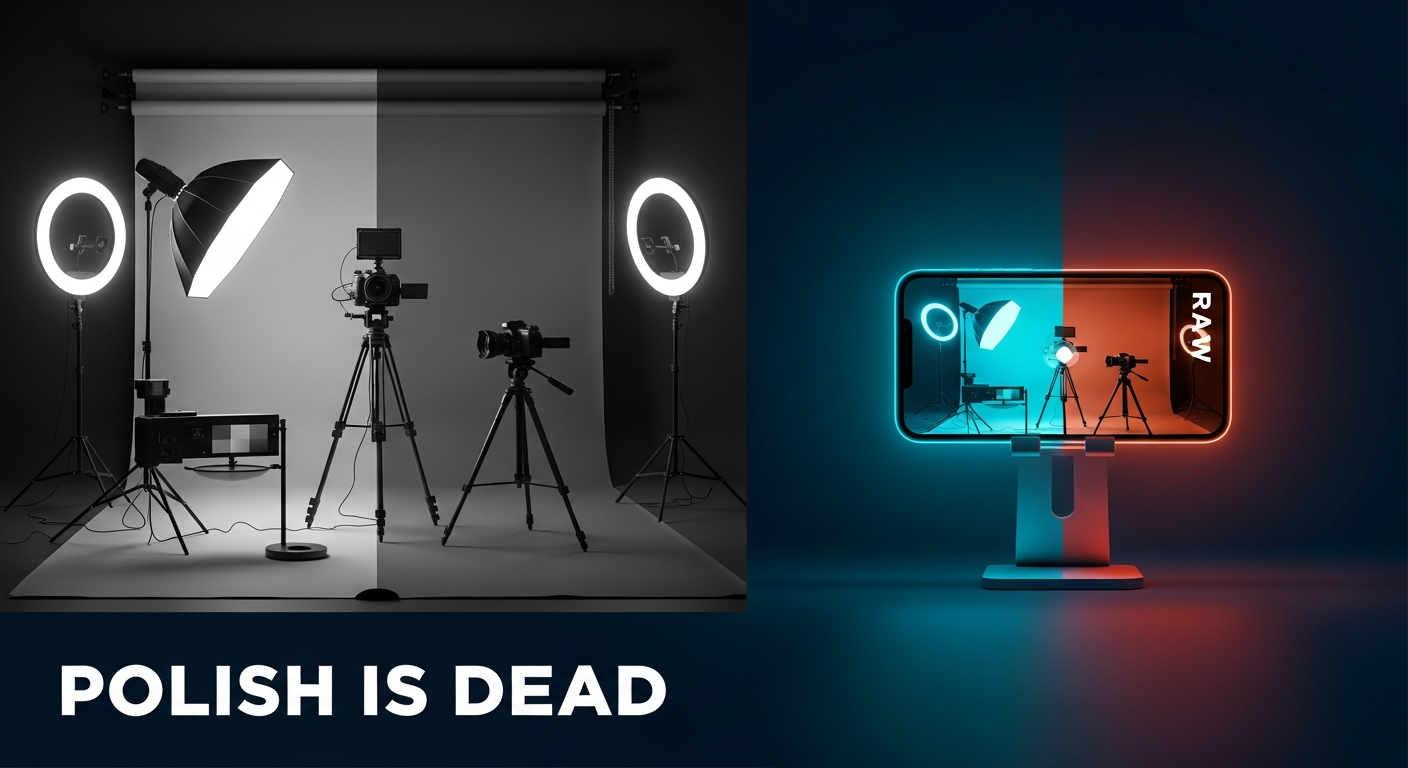
You spent $50K on a lighting rig, hired an editor, and built a production workflow. Meanwhile, your competitor posted a video on her phone, didn’t even reframe the shot, and got 10x your views.
That’s not bad luck. That’s the new YouTube algorithm rewarding authenticity and penalizing polish.
The creator economy is undergoing a quiet revolution that most marketers are completely ignoring. Platforms that built their empires on production value are now actively suppressing it. The thumbnails that worked two years ago are too busy. The intros that kept people watching are now friction. The high-fidelity sound mixing that cost you time and money? The algorithm doesn’t care — and your audience actively distrusts it.
What Changed: The Algorithm Flipped
For nearly a decade, YouTube rewarded polish. Better equipment meant better retention. Professional thumbnails meant more clicks. Dramatic intros kept people watching. This was the playbook that built a generation of creators and agencies.
But in 2025–2026, that playbook broke.
Creators are now ditching highly-produced videos in favor of authentic, unfiltered content. Thumbnails are getting simpler. Fancy edits are disappearing. The aesthetic shift isn’t cosmetic — it’s a direct response to platform algorithm changes that now favor viewer satisfaction and genuine engagement over clickthrough rate optimization.
Here’s what’s happening under the hood: YouTube’s AI is now measuring success by whether people actually finish the video, click away, come back, recommend it, and watch similar content from the same creator. It’s not measuring clicks. It’s measuring trust and retention. And guess what builds more trust? A creator who looks like they’re talking to a friend, not a camera crew.
The data backs this up. Creators who shifted to minimal editing and simple thumbnails are seeing 40–60% increases in watch time and recommended video placement. Meanwhile, the high-production channels are struggling with declining views and worse algorithmic placement.
Why Authenticity Now Beats Production Quality
This isn’t philosophical. It’s mechanical.
YouTube wants viewers to spend time on the platform. If a video looks too polished, too produced, too “advertised,” users unconsciously recognize it as trying to manipulate them. They watch less, skip more, and bounce to someone else’s channel. The algorithm sees this behavior and deprioritizes the content.
But when a creator posts a quick take, no fancy intro, minimal graphics, and just raw expertise or personality? Viewers sit through it. They comment more. They subscribe more. They watch the next video. That’s the behavior YouTube optimizes for.
It’s also why one of the biggest trends in 2026 is channels ditching their entire production setups. Successful creators are moving toward:
- Phone recording, no setup: Smartphone cameras are indistinguishable from professional gear now. The friction of setting up a studio is a feature loss, not a feature gain.
- Simple, one-color thumbnails: The eye-catching, multi-color, text-heavy thumbnails of 2020 are getting scrolled past. Clean, simple thumbnails with one focal point are outperforming.
- Minimal editing: Jump cuts are in. B-roll is out. Transitions are gone. If you mess up, you leave it in.
- No intro content: Skipping the 30-second intro and getting straight to value is now standard. Creators who front-load the value are keeping people for 8+ minutes instead of losing them in the first 10 seconds.
- Talking head format: The most popular videos right now are just someone looking at the camera and speaking. That’s it.
It’s almost a reversion to the pre-YouTube era of webcam content, except now it’s intentional strategy, not a limitation.
The Real Insight: Audiences Can Smell Desperation
Here’s what I’ve learned from working with creators and marketing teams: audiences have become hyperaware of production manipulation.
They grew up watching polished ads, sponsored content, and influencers with production teams. They learned to distrust that aesthetic. When they go to YouTube, they’re looking for real people solving real problems — not brands pretending to be creators.
The channels winning right now aren’t the ones with the best equipment. They’re the ones with the best ideas and the courage to deliver them raw. A 30-minute video of someone explaining how they grew to $1M in revenue with zero production quality will beat a 5-minute, perfectly-edited corporate message every single time.
This is why the “human premium” — the authenticity advantage — has never been stronger. You’re not competing on production value anymore. You’re competing on whether people believe you’re giving them the real thing.
What This Means for Your Strategy Right Now
If you’re still investing in production quality as your primary competitive advantage, you’re building in the wrong direction.
1. Kill Your Intro (Seriously)
The first 3 seconds of your video should be you delivering value or context. No logo animation. No theme music. No “Hey what’s up.” Get straight to the point. If the only thing between your idea and the viewer is your opening bumper, you’ve already lost.
2. Simplify Your Thumbnails
Pick one element: a face, a number, a question. One color palette. Minimal text. Stop trying to make your thumbnail a piece of art. Make it a sign that says “this is worth your time.” Your highest-performing thumbs are probably the simplest ones you’ve made.
3. Reduce Edit Friction
Stop looking for the perfect take. Record more, edit less. If you say something twice because you messed up the first take, leave both in. Your stutter makes you human. Your imperfection makes you trustworthy. Your willingness to show up unfiltered signals that you’re confident enough in your ideas that you don’t need to hide behind production.
4. Record on Your Phone
Modern phones shoot in 4K with better color science than camera rigs from five years ago. Set it on a stand. Point it at yourself. Hit record. Spend your money on better ideas, not better equipment.
5. Front-Load Value
The moment someone clicks, they should know why they clicked. In the first 10 seconds, they need to understand what they’ll learn or why they need to keep watching. No setup. No soft intro. Value first.
6. Build Habits, Not Just Views
The new algorithm prioritizes predictability. Post on a schedule your audience can count on. Be consistent with format and style. Let people know what to expect from you. This loyalty signal tells YouTube to push your content higher.
The Competitive Advantage Is Now Yours
Here’s the dark side: most creators and marketers still haven’t adapted. They’re still sinking tens of thousands into production setups, still agonizing over perfect edits, still opening every video with a 30-second intro.
That means the window for first-mover advantage is still open. If you’re willing to stop treating your YouTube channel like a broadcast TV show and start treating it like a conversation with a friend, you’re going to destroy your competition.
The brands and creators winning in 2026 aren’t the ones with the biggest budgets. They’re the ones with the clearest ideas and the guts to deliver them unfiltered. You don’t need a studio. You don’t need an editor. You don’t need a production team. You need confidence.
And here’s the kicker: this shift is happening across every platform. TikTok, Instagram Reels, YouTube Shorts — they’re all moving in the same direction. Raw beats polished. Authentic beats produced. The creator who showed up at 6 AM in sweats to film a quick tip is beating the creator with a $500 ring light and a color-graded preset.
Your old production playbook is now a liability. If you’re serious about building an audience, you need to embrace the opposite philosophy. Ship faster. Edit less. Show up more raw. Stop waiting for perfect and start shipping real.
The shift is clear: audiences don’t want Hollywood. They want honesty. YouTube’s algorithm knows this. Your competitors haven’t adapted yet. Now is the time to move.
Where to Go From Here
This is the exact kind of strategic shift that separates creators who blow up from creators who plateau. If you’re running a marketing team, building a personal brand, or trying to grow an audience, this matters more than you think.
I work with a small number of creators and companies each quarter on these kinds of strategic pivots — where to focus, what to kill, and how to reposition for the algorithm shifts that are happening right now. If you want to talk through your YouTube strategy and whether your current setup is working with the algorithm or against it, let’s jump on a call. Book a strategy session with me at EdwardRippen.com.
Everything I covered here goes 10x deeper in The Golden Goose Formula, my viral marketing strategy playbook. It covers the exact framework for building authentic content systems that win in 2026. If you don’t have your copy yet, grab it at EdwardRippen.com. The strategies in there were written for exactly this moment.
The window is open. But it won’t be for long. Most creators are about to start copying this trend, and when they do, the first-mover advantage disappears. The time to move is now.