
Automated YouTube Channels Are Replacing Content Creators — Here’s How to Compete
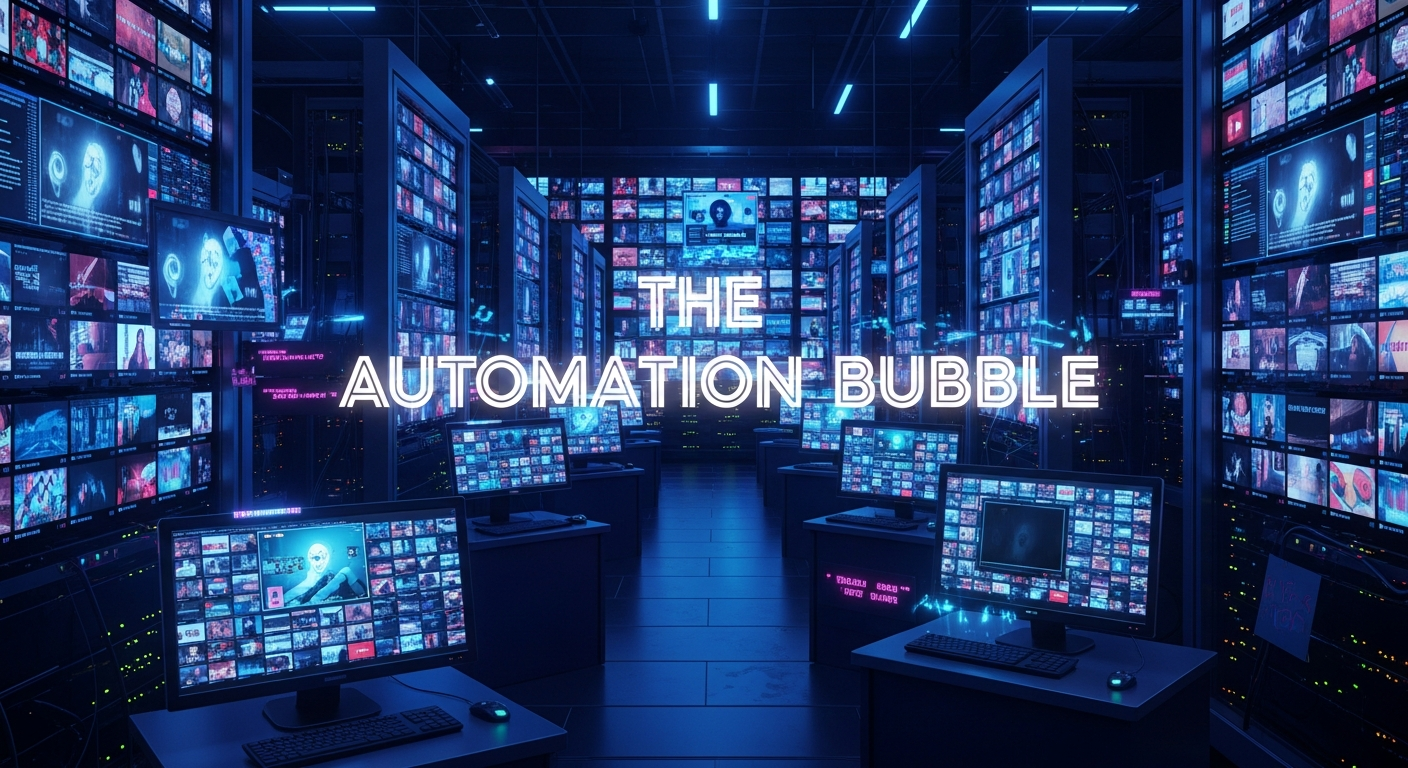
This is no longer a hypothetical. Fully automated YouTube channels—using AI to generate scripts, thumbnails, voiceovers, and video edits—are publishing daily and hitting six figures in subscribers. A year ago, we called this the future. Now it’s Wednesday.
If you’re a content creator, a brand running YouTube strategy, or a marketer who relies on organic video for lead gen, you need to understand what’s happening right now—and more importantly, how to position yourself to win instead of getting run over.
The Automation Wave Is Real (And Moving Faster Than You Think)
The infrastructure for fully automated content creation is now built into mainstream tools. ChatGPT generates scripts. DALL-E and Midjourney create visuals. AI voiceovers from tools like Eleven Labs and Google’s NotebookLM sound genuinely natural. Video editing platforms like Opus Clip and Synthesia automate the entire pipeline from concept to publication.
What changed? The barrier to entry disappeared. Six months ago, assembling these tools required technical knowledge and a budget. Now? It’s plug-and-play. A founder with $500 and basic internet literacy can spin up a YouTube channel that posts five videos a day, every day, forever—with zero human intervention beyond the initial setup.
YouTube’s own data confirms this isn’t fringe behavior. The search results show that automated YouTube channels are becoming a primary category—creators are outsourcing their entire production using AI software to design thumbnails, script videos, edit footage, and create voiceovers quickly. Some of these channels are hitting algorithmic success, and viewers often don’t notice or care that there’s no human on the other end.
Why This Breaks Traditional Creator Economics
The old model was simple: one creator, one channel, one personality. You built an audience around you. Monetization came from ads, sponsorships, and eventually, courses or digital products. Competition was fierce but manageable because you could only post so much content—you had a biological limit.
That constraint is gone.
Now a single person or small team can operate 10, 50, or 100 YouTube channels simultaneously. They don’t all need to be original. They can be micro-niches—productivity tips, stock market commentary, real estate insights, crypto analysis, fitness routines, philosophical rambles—each one powered by a different flavor of the same AI stack.
A channel that gets 500 views per day still makes money. Scale to 50 channels, and that’s $15,000+ a month in pure ad revenue. Scale to 200 channels, and you’re looking at a potential eight-figure business. No hiring. No drama. No burnout. Just machines feeding the algorithm.
For traditional creators, this is terrifying. You spent five years building an audience of 200,000 subscribers. Someone else just deployed capital and automation and built 50 channels with the same audience size in the same timeframe—with virtually zero effort.
The Conversation Nobody’s Having: The Algorithm Knows
YouTube’s algorithm is built to reward watch time, engagement, and retention. It doesn’t care if the content is human-made or AI-generated. It only cares about the signal.
But here’s what matters: YouTube knows the difference. And Google is watching how this plays out.
We’ve already seen this pattern with other Google properties. When SEO became automation-first, Google adjusted by rewarding experience, expertise, and authoritativeness (E-E-A-T). When fake reviews flooded Google Maps and product pages, Google built detection systems. When AI-generated images flooded image search, they introduced disclosure and ranking signals that favor verified, high-quality sources.
The same is happening on YouTube, but in slow motion. YouTube won’t ban AI content outright—too many legitimate creators use AI tools. Instead, they’ll gradually shift the ranking algorithm to favor channels with consistent personality, verifiable creator identity, and real engagement (versus algorithmic engagement).
In other words: the short-term gold rush of automated channels will work for the next 12–18 months. After that? The algorithm will optimize against pure automation, and those channels will become toast.
So How Do You Actually Compete?
1. If You’re a Creator: Lean Into What AI Can’t Fake
AI can generate content at scale. AI cannot generate trust, personality, or parasocial relationship.
The creators winning right now are doubling down on authenticity and real-time responsiveness. They’re going live. They’re responding to comments within hours. They’re showing their face. They’re building community (not just content). They’re creating campaigns that unfold in real-time, responding to what the audience is saying.
This is the opposite of automation. But it’s also the only sustainable moat. Use AI to handle production grunt work (editing, graphics, research summaries), but keep your voice, your opinions, and your personality non-negotiable.
2. If You’re a Brand: Stop Treating YouTube Like a Broadcast Channel
Most brands use YouTube like TV—dump a polished, produced video and hope it ranks. That’s dead. Completely.
Automated channels own the “polished content in niche categories” space. Brands need to own the “real conversation” space. This means behind-the-scenes content, founder perspectives, customer stories, technical breakdowns, and transparent problem-solving. It means building community, not broadcasting.
Brands that are winning right now treat YouTube like the beginning of community, not the end goal. They use it to drive traffic to Discord, build email lists, and create recurring engagement loops.
3. Embrace YouTube Topic Insights to Stay Ahead of the Trend Cycle
Google released YouTube Topic Insights, an open-source Gemini tool that automatically identifies trending content and top creators in your niche. Instead of guessing what your audience wants, you can now see exactly which topics are gaining momentum in your category.
Use this to identify gaps—topics that are trending but under-covered, or angles that established automated channels haven’t touched yet. Move fast. Publish first. Own the angle before the AI farms find it.
4. Build a “Human-Verified Creative” Positioning
In a landscape of automation, there’s a growing premium for content that’s clearly human-made. Not rough or unpolished—but unmistakably created by someone with expertise and perspective.
I call this “Human-Certified Creative,” and it’s becoming a competitive advantage. Your thumbnail might be AI-assisted, but your script is original. Your voiceover is you (or a voice actor hired for personality, not just speed). Your editing is intentional, not algorithmic.
Signal this in your content. Name yourself in your about section. Show your face in intros. Build a small email community. Create exclusive content. Do the things that prove there’s a real human behind the channel.
5. Go Niche and Go Deep
Automated channels thrive in broad categories—finance tips, productivity hacks, workout routines. They fall apart in specialist communities where audience members expect nuance, updated expertise, and real accountability.
If you’re a SaaS founder, don’t compete on “productivity YouTube.” Instead, become the voice of a specific software category. If you’re a marketer, don’t chase “marketing tips.” Instead, own a narrow angle: B2B Reddit strategy, AI disclosure for creators, or nostalgia marketing in CPG.
Automated channels can’t follow you there. They lack the lived expertise. The moment you establish yourself as THE voice in a specific corner, the algorithm starts working for you instead of against you.
The Real Play: Use Automation, Don’t Become It
Here’s the move that actually works: Build your channel with your personality and perspective as the core asset. Then use AI tools to amplify it.
Use ChatGPT to outline scripts, not write them. Use AI voiceover to create variations, not replace your voice. Use automated editing to speed up production, not eliminate creative decisions. Use YouTube Topic Insights to identify opportunities, not just copy trending angles.
The creators, brands, and marketers who win in the next two years will be the ones who understand that AI is a tool, not a business model. Fully automated channels are the equivalent of splashing money on ads and hoping something sticks—it works until the algorithm optimizes against it, and then you’re left with nothing.
Real growth comes from building something that can’t be replicated by running a script. That’s personality. Expertise. Community. Trust.
The Window is Closing
If you’re thinking about launching automated channels as a side business, you have maybe 18 months before the playbook gets crowded and the algorithm adjusts. Move now or don’t move at all.
If you’re an existing creator worried about being disrupted, stop worrying and start building your moat. Lean into what you do that automated channels can’t—direct connection to your audience, real-time response, authentic personality, community leadership.
The brands that survive this shift will be the ones that move fast on the tactics (using AI for production, speed, scale) but never compromise on the strategy (building trust and community). That’s not AI versus human. It’s AI plus human, done right.
This is exactly the kind of strategic decision we dig into during a consultation. If you’re running YouTube as a growth channel or thinking about launching a creator business, you need a clear strategy that accounts for automation, algorithm changes, and real competition. Book a strategy session with me at EdwardRippen.com—I work with a small number of founders and brands each quarter, and if you’re serious about YouTube growth, we should talk.
And if you want the full viral growth framework I use to build sustainable channels and brands, grab The Golden Goose Formula—it covers exactly how to build competitive advantages that AI can’t replicate. Get it at EdwardRippen.com.
The difference between winning and losing on YouTube in 2026 isn’t who has the best AI tools. It’s who understands that tools are only half the battle.